Table of Contents
1. The Myth of Perfect Anonymity
Tor does not make you invisible — it makes you harder to track. This is an important distinction. The Tor network provides strong anonymity against most adversaries, but it is not a magic shield against a well-resourced, determined law enforcement agency.
The vast majority of dark web users are never identified by law enforcement. Most arrests do not come from breaking Tor's cryptography — they come from user mistakes, informants, and operational security failures. Understanding how agencies actually catch people is essential for anyone interested in digital privacy.
2. Traffic Analysis & Timing Attacks
The most technically sophisticated attack against Tor is traffic correlation. The concept: if an adversary controls both the entry point of your Tor circuit (the guard node) and the exit point, they can potentially correlate your traffic by timing analysis — matching when packets enter and exit the network.
This requires a "global passive adversary" — an entity that can observe a significant portion of internet traffic simultaneously. Intelligence agencies like the NSA have this capability in theory. In practice, mounting a successful timing attack against a specific individual requires knowing who to target in advance and sustained observation.
For onion services (hidden services), this attack is harder because traffic never exits the Tor network. The attacker would need to control multiple nodes in the circuit connecting the client to the service.
Traffic analysis is a real threat primarily for high-value targets of national intelligence agencies. For the average person using Tor for privacy, this attack is not a practical concern — assuming no OPSEC failures.
3. Exit Node Monitoring
Exit nodes are where Tor traffic leaves the Tor network and enters the regular internet. Law enforcement agencies and intelligence services operate a meaningful percentage of exit nodes. Traffic passing through these nodes that is not encrypted by HTTPS is visible to the exit node operator.
This matters when accessing regular websites through Tor. The exit node operator can see: the destination URL, unencrypted request/response content, and timing information. They cannot see your real IP address — but if you log into an account connected to your real identity while using Tor, you have defeated the anonymity Tor provides.
For onion services, exit nodes are irrelevant — traffic stays within the Tor network from client to server.
4. Honeypot Operations
Law enforcement regularly operates fake dark web services. These honeypots are designed to attract users attempting to access illegal goods or services. When a target service is seized, agencies sometimes continue to operate it covertly to identify and collect evidence against users.
Operation Onymous (2014) took down over 400 onion services. AlphaBay/Hansa (2017) saw Dutch police run Hansa for a month after takedown, collecting data on buyers and sellers. Operation DisrupTor (2020) resulted in 179 arrests across multiple countries.
The honeypot risk is specific to users seeking illegal services. Simply browsing a Hidden Wiki directory does not expose you to honeypot risk — interacting with illegal services does.
5. Cryptocurrency Tracing
Early dark web users assumed Bitcoin transactions were anonymous. They are not — they are pseudonymous. Every Bitcoin transaction is permanently recorded on the public blockchain.
By 2026, blockchain analysis firms like Chainalysis, Elliptic, and CipherTrace can trace Bitcoin flows with high accuracy. They use techniques including:
- Cluster analysis — grouping addresses controlled by the same entity
- Peel chain analysis — following transaction chains
- Exchange tagging — when funds reach a regulated exchange that requires KYC, the real identity is revealed
- Dust attacks — sending tiny amounts to addresses to track their activity
Monero (XMR) was designed specifically to address Bitcoin's traceability. It uses ring signatures, stealth addresses, and RingCT to obscure sender, receiver, and amount. As of 2026, no public tool can reliably trace Monero transactions, though law enforcement agencies claim to have made progress on earlier Monero versions.
6. OPSEC Failures — What Really Gets People Caught
The single biggest factor in dark web arrests is not sophisticated surveillance — it is operational security failures. Case studies consistently show that people are caught because of their own mistakes:
- Reusing usernames — using the same username on dark web forums and clear web sites
- Reusing passwords — passwords from dark web accounts appearing in data breaches
- Posting personal information — mentioning real locations, schedules, or identifiable details in dark web communities
- Using real email addresses — registering dark web accounts with emails linked to real identities
- Shipping to real addresses — ordering physical goods to home addresses
- Logging into personal accounts while on Tor — accessing Gmail, Facebook, or other identified accounts defeats Tor's purpose
- Bragging — telling friends about activities, which leads to informants
Ross Ulbricht (Silk Road founder) was caught largely because he used his real email address in early forum posts about Silk Road and posted questions about Tor server administration under his real identity on Stack Overflow.
7. Malware & Browser Exploits
The FBI and other agencies have used malware — sometimes called "network investigative techniques" (NITs) — to identify Tor users. The most famous case was Operation Playpen in 2014-2015, where the FBI deployed a Flash exploit in the browser to reveal real IP addresses of visitors.
The defense is straightforward: run Tor Browser at its Safest security level, which disables JavaScript and most potentially exploitable browser features. With JavaScript disabled, browser-based exploits cannot execute.
Using Tails OS provides additional protection: even if malware executes, Tails runs entirely in RAM and leaves no persistent state. The malware cannot write to disk or persist beyond the session.
8. Informants & Infiltration
Human intelligence remains one of law enforcement's most effective tools against dark web communities. Agencies infiltrate forums and markets by posing as users, vendors, or administrators. When a community grows large enough, the probability of at least one member being an informant or undercover officer approaches certainty.
This is why operational compartmentalization matters: do not discuss real-world activities in dark web forums, do not meet people from dark web communities in person, and treat all communications as potentially monitored.
9. International Cooperation in 2026
By 2026, international law enforcement cooperation for cybercrime has reached unprecedented levels. Europol's European Cybercrime Centre (EC3), the FBI's Cyber Division, and equivalents in Australia, Canada, the UK, and increasingly Asia-Pacific share intelligence and coordinate takedowns in real time.
Joint operations now routinely span dozens of countries. The practical implication: hosting a dark web service in a country with lax cybercrime laws is no longer reliable protection, as agencies pursue servers through mutual legal assistance treaties (MLATs) or simply seize them with local cooperation.
10. What Is Actually Legal to Browse
Browsing the dark web — including the Hidden Wiki — is not illegal in most countries. Tor is a legitimate tool used by journalists, activists, researchers, and privacy-conscious individuals worldwide. Simply visiting a dark web directory is the same legally as visiting a directory on the regular internet.
What matters is what you do: purchasing illegal goods, accessing illegal content, or participating in criminal marketplaces is illegal regardless of whether you use Tor. The anonymity Tor provides does not change the legal status of an action.
For legitimate users — people using Tor to access censored news, to communicate privately, or simply to browse without tracking — law enforcement is not a meaningful concern. Agencies have limited resources and focus them on serious criminal activity, not general privacy use.
Tor's anonymity is strong against most adversaries. Real arrests come from OPSEC mistakes, not from breaking Tor's cryptography. Use Tor Browser at Safest level, never mix identities, and never log into personal accounts while using Tor.
Related Articles

OPSEC for Everyday People: Protect Your Digital Life
Threat modeling, compartmentalization, pseudonyms, metadata scrubbing — for everyday people.
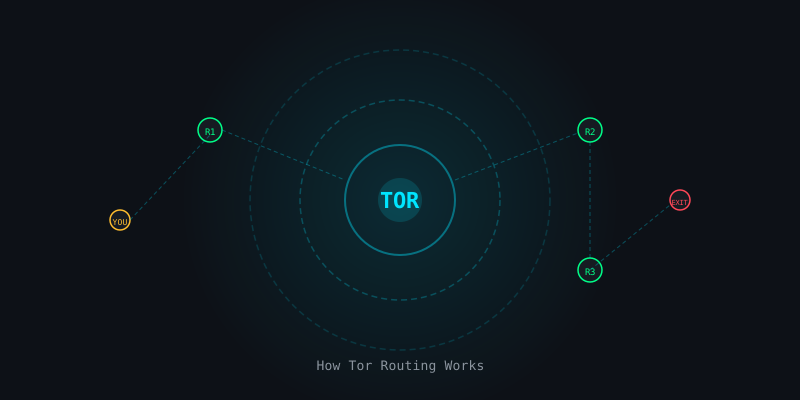
The Complete Beginner's Guide to the Tor Network
How onion routing works, how to use Tor Browser safely, and what Tor can and cannot protect you from.
Dark Web Marketplace Deaths: A Technical Post-Mortem of 10 Collapses
Empire took $30M. Evolution took $12M. A technical dissection of how 10 major markets collapsed.