Table of Contents
1. The Bitcoin Anonymity Myth
Bitcoin is pseudonymous, not anonymous. Every transaction is recorded permanently on a public blockchain that anyone can read. Your wallet address is not directly tied to your name — but tracing Bitcoin to a real identity is often straightforward for anyone with the right tools.
The key insight: all Bitcoin transactions are public and permanent. The blockchain records every input, every output, every amount, and every address. This information never disappears. A transaction you make today can be traced years later with tools that didn't exist when you sent it.
Bitcoin does not make you anonymous. It makes you pseudonymous with a permanent public audit trail. Blockchain analytics companies like Chainalysis and CipherTrace can trace the vast majority of Bitcoin transactions and sell this capability to governments and exchanges globally.
2. How Chain Analysis Works
Chain analysis firms use several techniques to de-anonymize Bitcoin users:
Address Clustering
Bitcoin transactions often spend from multiple input addresses at once. Chain analysis assumes these inputs are controlled by the same person — clustering them as a single entity. This single heuristic is remarkably powerful and allows analysts to build large clusters of addresses belonging to one wallet.
Exchange KYC as Identity Anchors
Most regulated cryptocurrency exchanges require identity verification (KYC — Know Your Customer). When you withdraw Bitcoin from an exchange to your own wallet, the exchange knows which address belongs to you. Chain analysis then traces transactions forward from that address across the blockchain.
Common Spend Patterns
Change addresses, round-number amounts, and transaction timing all leak behavioral patterns that can be used to cluster wallets or identify specific users.
On-Chain to Real-World Correlation
If you ever pay for something that ships to your physical address, receive funds from a known exchange withdrawal, or post a Bitcoin address publicly, that address is linked to your identity. The link persists on the blockchain permanently.
3. Monero: How It Achieves Privacy
Monero (XMR) is a cryptocurrency designed from the ground up to be private by default. Unlike Bitcoin — where privacy is optional and mostly ineffective — Monero applies privacy-preserving cryptography to every transaction automatically. There is no way to make a non-private Monero transaction.
Monero's privacy stack has three main components: ring signatures, stealth addresses, and RingCT (Ring Confidential Transactions). Together, they hide the sender, receiver, and amount of every transaction.
4. Ring Signatures & Stealth Addresses
Ring Signatures
When you send Monero, your transaction input is mixed with outputs from other users on the blockchain, called "decoys." The result is a ring signature — a cryptographic proof that one member of the group signed the transaction, without revealing which member. An outside observer cannot determine which input is the real one.
The default ring size in Monero is 16 (one real input + 15 decoys). This provides plausible deniability for every transaction output.
Stealth Addresses
Rather than sending to a recipient's permanent address, Monero generates a one-time stealth address for each transaction. Only the recipient can detect and spend funds sent to their stealth addresses. An outside observer cannot link multiple transactions to the same recipient.
RingCT (Confidential Transactions)
RingCT hides transaction amounts using Pedersen commitments — a cryptographic technique that proves an amount is valid (no coins were created from nothing) without revealing the actual value. On Monero's blockchain, you cannot see how much XMR was sent in any transaction.
5. Zcash: Optional Privacy
Zcash uses zk-SNARKs (zero-knowledge proofs) — cryptography that is arguably stronger than Monero's ring signatures. However, Zcash has a critical practical weakness: privacy is opt-in.
The majority of Zcash transactions use the transparent (t-address) mode, which offers no more privacy than Bitcoin. Only transactions using shielded (z-address) addresses are private. When most transactions are transparent, the rare shielded transactions stand out and can attract scrutiny.
Monero's advantage is that every transaction is private by default — there is no distinction between "private" and "non-private" transactions to identify.
6. Privacy Coin Comparison
| Feature | Bitcoin | Monero (XMR) | Zcash (ZEC) |
|---|---|---|---|
| Sender hidden | ❌ | ✅ Ring sigs | ✅ (shielded only) |
| Receiver hidden | ❌ | ✅ Stealth addresses | ✅ (shielded only) |
| Amount hidden | ❌ | ✅ RingCT | ✅ (shielded only) |
| Private by default | ❌ | ✅ | ❌ |
| Auditable by user | ✅ | ✅ (view keys) | ✅ |
| Exchange availability | Universal | Limited (delisted many) | Moderate |
7. How to Acquire Monero Privately
The weakest point in Monero privacy is acquisition — how you get XMR in the first place.
- P2P exchanges — LocalMonero (now merged into AgoraDesk) allows peer-to-peer XMR trades with cash, bank transfer, or other methods. The privacy depends on the payment method used.
- Atomic swaps — Bitcoin-to-Monero atomic swaps allow you to trade BTC for XMR without a centralized exchange, though the BTC side may be traceable to your identity.
- Mining — Monero uses the RandomX proof-of-work algorithm, optimized for CPU mining. Mining XMR and receiving it directly to your wallet is the most private acquisition method, as mined coins have no transaction history.
- Centralized exchanges — Many major exchanges have delisted Monero due to regulatory pressure. Those that still offer XMR require KYC, linking your identity to the purchase.
8. Using Monero Safely
- Use the official Monero wallet — Download from
getmonero.orgonly. Hardware wallet support is available via Ledger. - Run your own node — Using a remote node means the node operator can see your IP and which transactions you query. Run a local node for maximum privacy.
- Combine with Tor — Run your Monero wallet over Tor to hide your IP from the network. The official Monero wallet supports Tor connections.
- Never reuse addresses — Monero generates stealth addresses automatically, but be aware of this principle when generating payment addresses manually.
- Use subaddresses — When receiving from multiple sources, use subaddresses to prevent linking different payments to the same account.
9. Legal Status in 2026
Monero itself is legal to own and use in most jurisdictions. However, regulatory pressure has resulted in several consequences:
- Many regulated exchanges have delisted XMR due to FATF (Financial Action Task Force) travel rule requirements
- South Korea, Japan, and Australia have effectively banned Monero from regulated exchanges
- The EU's MiCA regulation creates compliance hurdles for privacy coins
- Despite this, no country has made it illegal to hold or transact in Monero — the restrictions are primarily on regulated exchange listings
The practical effect: Monero is harder to acquire through traditional channels but remains functional as a private payment system through P2P and decentralized methods.
For genuine financial privacy, Monero is the most battle-tested option available. Bitcoin provides no meaningful anonymity for anyone who has ever used a KYC exchange. Combine Monero with Tor and good OPSEC for the strongest available protection.
Related Articles
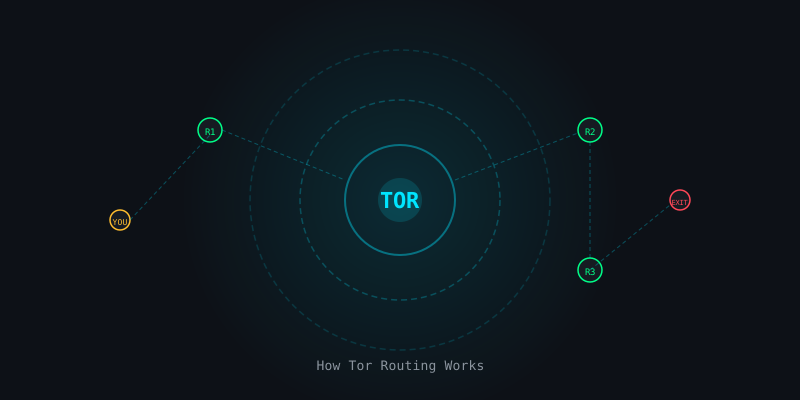
The Complete Beginner's Guide to the Tor Network
How onion routing works, how to use Tor Browser safely, and what Tor can and cannot protect you from.

OPSEC for Everyday People: Protect Your Digital Life
Threat modeling, compartmentalization, pseudonyms, metadata scrubbing — for everyday people.
Dark Web Marketplace Deaths: A Technical Post-Mortem of 10 Collapses
Empire took $30M. Evolution took $12M. How 10 major dark web markets collapsed.